Your colour

A habit-tracking app for cutting back, not quitting

Do less
without quitting.

HabitBuffer puts a weekly number on the things you’d rather do less of: gaming, scrolling, streaming, takeaways. What you don’t use comes back as hours or money towards something you actually want.

Designed and developed by a psychotherapist, made so one bad day doesn’t undo a good week.

Out now on Android (UK) · coming soon to iPhone and the web

No spam. Unsubscribe any time. How we handle your email.

HabitBuffer Less scrolling now.
Evenings back sooner.

A weekly number for the things you’d rather do less of. What you don’t use becomes hours back or money kept.

Get started No account needed. Nothing resets.
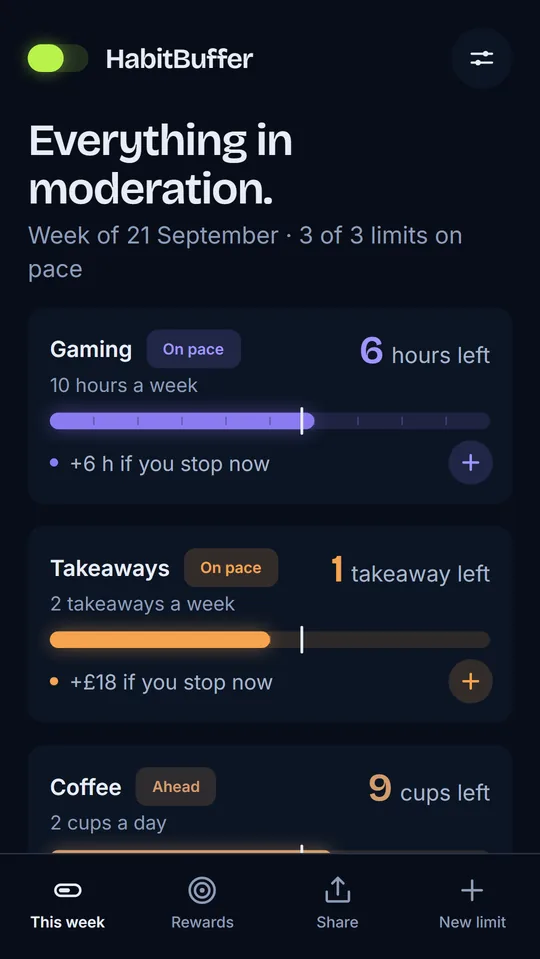
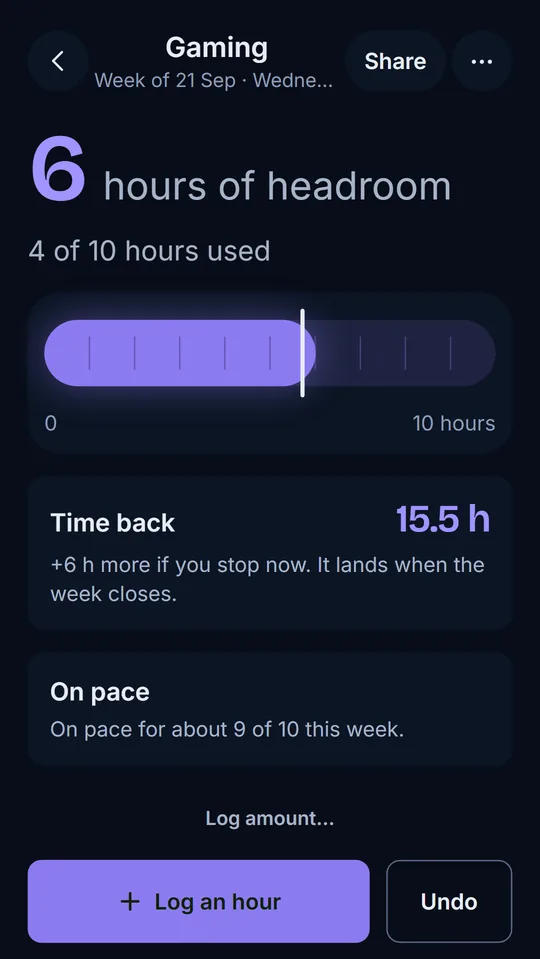
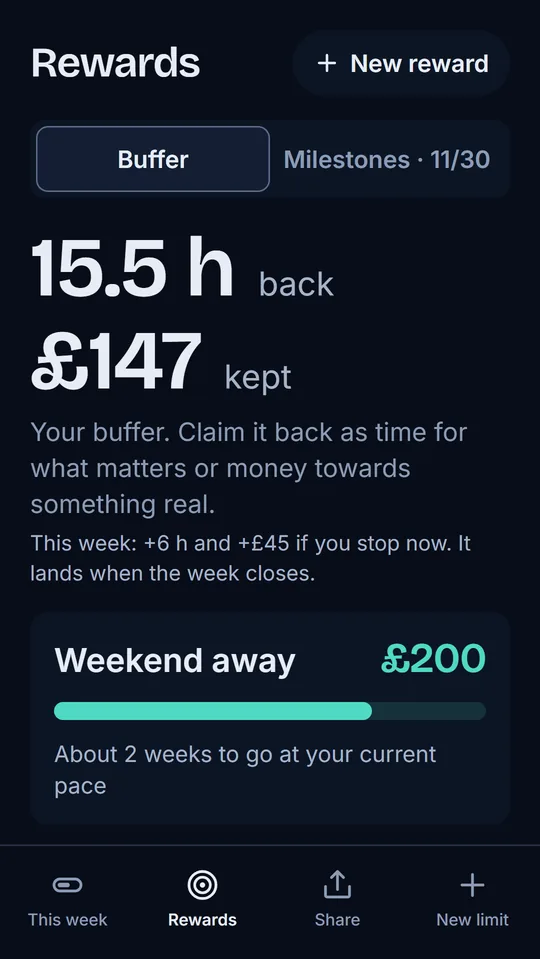
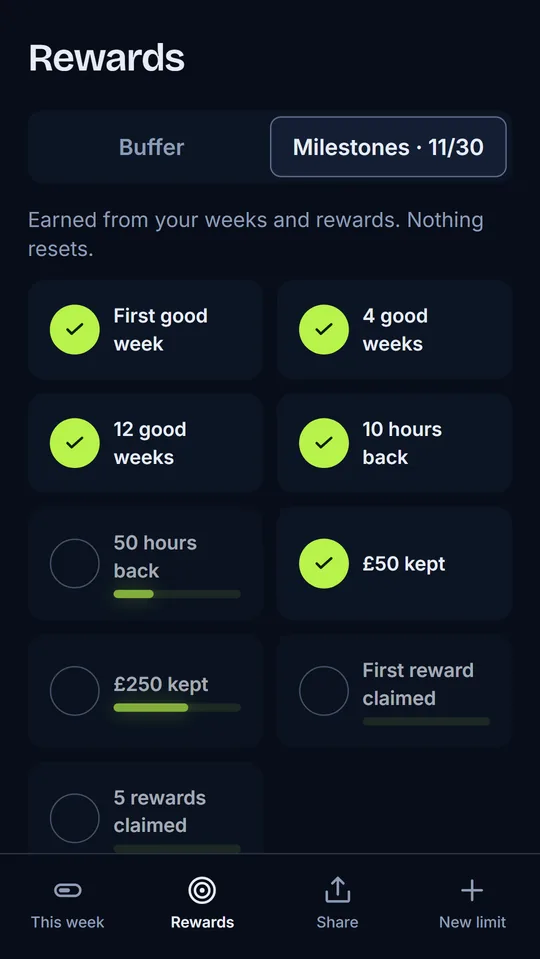
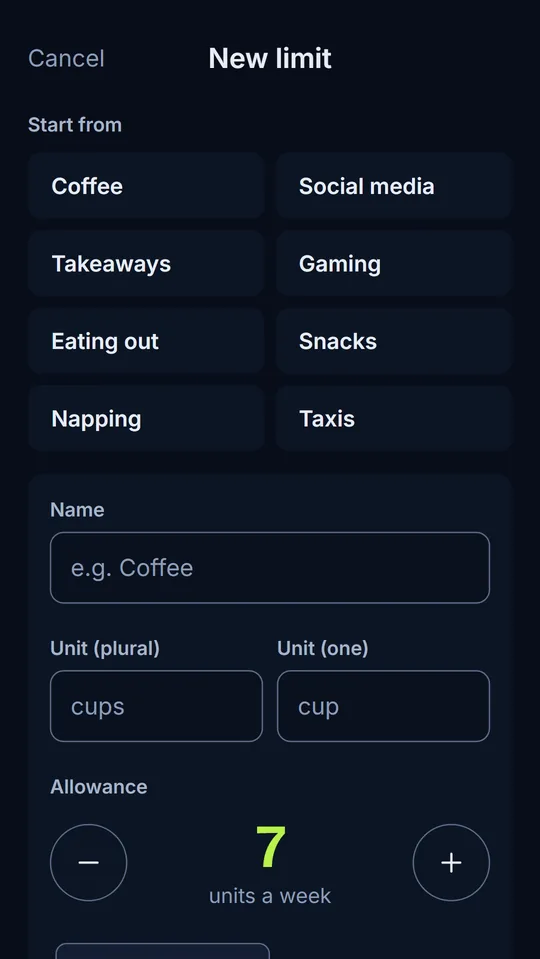
New limit: start from Coffee, Social media, Takeaways, Gaming, Streaming, Spending, Eating out, Snacks, Napping or Taxis. Home, this week: Gaming, on track, 6 hours left of 10, plus 6 hours if you stop now, with a Log half-hour button. Takeaways, on track, 1 left, plus £18. Gaming: 6 hours of headroom, 4 of 10 used. On track, heading for about 9 of 10 this week. Rewards: 15.5 hours back and £147 kept. Weekend away, about 2 weeks to go. Milestones: 9 of 30 found, such as First week under, £50 kept and Bounced back. Each stays hidden until you earn it.
Welcome to HabitBuffer

Treat habits like a budget.

You already know how a budget works: decide what you’re comfortable with, keep track, and what’s left is yours. HabitBuffer does the same for behaviour.

  1. Set a limit

    10 hours of gaming a week, 2 takeaways, 5 high street coffees. Your number, your call.

  2. Log what you use

    One tap to log, one tap to undo.

  3. Watch your pace

    A notch on each bar shows where an even week would be. Well under, On track or Running high tells you where you stand.

  4. Keep what’s left

    When the week closes, the unused part lands in your buffer.

An example Wednesday.

Hours limits give hours back. Limits with a cost give money kept.

  • Gaming+6 h10 hours a week · 4 used · 6 hours left
  • Takeaways+£182 a week at £18 · 1 used · skip it and £18 is kept
  • High street coffee+£13.805 a week at £4.60 · 2 had · 3 left

Stop now and that’s what lands in your buffer when the week closes.

Gaming detail: 6 hours of headroom, 4 of 10 hours used. Time back 15.5 hours, plus 6 more if you stop now. It lands when the week closes. On track, heading for about 9 of 10 this week.

The goal isn’t zero. It’s your number.

You don’t need to quit gaming. You don’t need to swear off takeaways, or become the person who never buys a coffee. Decide what “less” looks like for you, and stay under it most weeks.

Go over and that’s one week. No streak breaks, nothing resets, and nothing turns red.

Most habit trackers

Keep the streak alive.

Quit apps

Stop completely.

HabitBuffer

Pick your number and keep what you don’t use.

Rewards: 15.5 hours back and £147 kept. Weekend away, £200, about 2 weeks to go at your current pace.

Put it towards something real.

Pick a reward, like time for that guitar lesson or a weekend away, and see roughly how many weeks it will take at your pace.

  • Weekly limits in hours, cups, meals or anything else.
  • Quick logging. One tap on Log, one to undo.
  • Your buffer. Unused hours come back as time; unused spend is kept as money.
  • Milestones. 30 to earn, each one a surprise until you do. Once earned, never lost.
  • Works offline. No account, no connection needed.

Your habits are yours.

  • No account needed. Your limits and logs stay on your device.
  • No ads. Your data is never sold.
  • Export everything as JSON or CSV, free, any time.
  • Delete everything from Settings in one step.

HabitBuffer is a self-management tool, not medical advice or treatment.

Free to use.

  • Up to 3 habits
  • 1 reward at a time
  • Weekly share cards, all your habits on one
  • Milestones and offline use

ProLater will add unlimited habits and rewards, the full-year view, and monthly and yearly share cards.

Questions

Do I have to quit anything?

No. HabitBuffer is for moderation. Set a limit that works for you and aim to stay under it.

What happens if I go over?

Nothing resets. That week just doesn’t add to your buffer, and you carry on next week. Your buffer and milestones stay earned.

What is the buffer?

What you didn’t use, counted when the week closes. Hours limits give hours back. Limits with a cost per unit (like £18 a takeaway) give money kept. You put it towards rewards you choose.

Is the money real?

It’s money you didn’t spend, not money held for you. HabitBuffer keeps count so you can treat yourself on purpose.

When can I get it?

It’s out now on Android in the UK: get it on Google Play. iPhone and the web are coming soon; sign up for exclusive founder discounts and information, and we’ll tell you the moment they open.

Does it work offline?

Yes. Everything works without a connection or an account.

Can I get my data out?

Yes. Export JSON or CSV from Settings, free. You can also delete everything there.

Is HabitBuffer a treatment for addiction?

No. It’s a self-management tool for cutting back on everyday habits. If cutting back feels hard, the app points to support such as NHS Every Mind Matters, MoneyHelper and your GP.

Less, not none.

Out now on Android in the UK. Coming soon to iPhone and the web.
Get it on Google Play

iPhone or web? Sign up for founder discounts

Why I built HabitBuffer this way

My day job is as a psychotherapist. Stress, overwhelm and anxiety are things I come across and work with every day. Again and again, I see how hard people are on themselves when they slip, and how that harshness tends to make change harder, not easier.

So I wanted a tracker that felt kind to use. Three ideas from psychology shaped it. Below is roughly how each one works, the research I drew on, and how it found its way into the app. It’s a gentle guide, not a promise: people are different, and the research has its limits, which I’ve tried to be honest about.

1. Stress and the thinking brain

The idea

When we feel under threat, the body’s stress response switches on: the “fight or flight” reaction first described over a century ago1, with cortisol as one of its main hormones2. Lab research suggests it rises most when we feel judged or out of control3. Stress can also make it harder for the prefrontal cortex, the part of the brain that plans and weighs things up, to do its job, so we fall back on quicker, more habitual responses4,5.

Feeling judged often nudges us away from things rather than towards them. Goals built around fear of failing can drain motivation6, and putting things off is often a way of easing a difficult feeling in the moment7.

How this shaped the appNothing in HabitBuffer turns red, and there are no warnings or telling-offs. Your week is described as “Well under”, “On track” or “Running high”: gentle information rather than a verdict. I wanted something you can glance at without bracing yourself.

To be fair to the evidence: nobody has measured cortisol in people using habit apps, so I’m not claiming the app changes your hormones. You may also read that the colour red itself makes people anxious. Those findings haven’t held up well8. I avoid red simply because it so often reads as judgement.

2. Expectancy violation (inhibitory learning)

The idea

We tend to learn most when things turn out differently from what we expected. That gap between expectation and reality sits at the heart of a classic model of learning9. Old expectations don’t simply disappear. New learning grows alongside them10. In therapy for anxiety, this is part of how people learn that a feared outcome doesn’t always happen11,12, and researchers are now exploring the same idea in mood and pain13,14.

With habits, the feared outcome is often a spiral: “I’ve blown it now, so I might as well carry on.” Researchers call this the abstinence violation effect15,16. Meeting a slip with kindness seems to help. In studies, it was linked to people eating less afterwards17, feeling more motivated to improve18 and procrastinating less next time19.

How this shaped the appMany trackers quietly teach us that one slip costs everything, because the streak goes back to zero. HabitBuffer tries to gently show something different. Go over and it’s just one week. Your buffer stays, your milestones stay, and next week starts fresh, which can be motivating in itself20. Over time, I hope each “that wasn’t a disaster after all” makes starting again feel a little easier.

To be fair to the evidence: this approach comes from therapy for anxiety. Using it in a habit app is my own reasoning from that work, and it hasn’t been formally tested in an app.

3. Dopamine and positive reinforcement

The idea

We’re more likely to repeat things that feel rewarding. That’s positive reinforcement, first studied by Skinner21, and how and when rewards arrive shapes how steady a habit becomes22. Dopamine plays a part in this learning. It seems to respond most to things that turn out better than we expected23,24, and it’s linked more to wanting and motivation than to pleasure itself25.

Streaks can work against us here. In one set of studies, people did an activity less after seeing a streak broken26. Seeing progress tends to help: keeping track of progress supports people in reaching their goals27, people often speed up as a reward gets closer28, and small wins can lift motivation29.

How this shaped the appYour buffer only ever adds up, so there’s nothing to lose. Rewards you choose show roughly how many weeks are left. Milestones stay hidden until you earn them, so each one can arrive as a small, pleasant surprise, and one of them is simply for bouncing back after a harder week. I wanted the app to celebrate coming back, not being perfect.

To be fair to the evidence: you’ll often read about “dopamine hits” and “dopamine crashes”. They haven’t been measured in app users, and dopamine is more complicated than that. The simpler, better-supported point is that seeing progress you can’t lose helps people keep going.

References (29)
  1. Cannon, W. B. (1915). Bodily changes in pain, hunger, fear and rage. D. Appleton & Company. doi.org/10.1037/10013-000
  2. McEwen, B. S. (1998). Protective and damaging effects of stress mediators. New England Journal of Medicine, 338(3), 171–179. doi.org/10.1056/NEJM199801153380307
  3. Dickerson, S. S., & Kemeny, M. E. (2004). Acute stressors and cortisol responses: A theoretical integration and synthesis of laboratory research. Psychological Bulletin, 130(3), 355–391. doi.org/10.1037/0033-2909.130.3.355
  4. Arnsten, A. F. T. (2009). Stress signalling pathways that impair prefrontal cortex structure and function. Nature Reviews Neuroscience, 10, 410–422. doi.org/10.1038/nrn2648
  5. Arnsten, A. F. T. (2015). Stress weakens prefrontal networks: Molecular insults to higher cognition. Nature Neuroscience, 18(10), 1376–1385. pmc.ncbi.nlm.nih.gov/articles/PMC4816215/ Free to read
  6. Elliot, A. J., & Church, M. A. (1997). A hierarchical model of approach and avoidance achievement motivation. Journal of Personality and Social Psychology, 72(1), 218–232. doi.org/10.1037/0022-3514.72.1.218
  7. Sirois, F., & Pychyl, T. (2013). Procrastination and the priority of short-term mood regulation: Consequences for future self. Social and Personality Psychology Compass, 7(2), 115–127. doi.org/10.1111/spc3.12011
  8. Gnambs, T. (2020). Limited evidence for the effect of red color on cognitive performance: A meta-analysis. Psychonomic Bulletin & Review, 27(6), 1374–1382. doi.org/10.3758/s13423-020-01772-1
  9. Rescorla, R. A., & Wagner, A. R. (1972). A theory of Pavlovian conditioning: Variations in the effectiveness of reinforcement and nonreinforcement. In A. H. Black & W. F. Prokasy (Eds.), Classical conditioning II (pp. 64–99). Appleton-Century-Crofts. Overview: www.scholarpedia.org/article/Rescorla-Wagner_model Free to read
  10. Bouton, M. E. (2004). Context and behavioral processes in extinction. Learning & Memory, 11(5), 485–494. doi.org/10.1101/lm.78804
  11. Craske, M. G., Kircanski, K., Zelikowsky, M., Mystkowski, J., Chowdhury, N., & Baker, A. (2008). Optimizing inhibitory learning during exposure therapy. Behaviour Research and Therapy, 46(1), 5–27. doi.org/10.1016/j.brat.2007.10.003
  12. Craske, M. G., Treanor, M., Conway, C. C., Zbozinek, T., & Vervliet, B. (2014). Maximizing exposure therapy: An inhibitory learning approach. Behaviour Research and Therapy, 58, 10–23. doi.org/10.1016/j.brat.2014.04.006
  13. Rief, W., Glombiewski, J. A., Gollwitzer, M., Schubö, A., Schwarting, R., & Thorwart, A. (2015). Expectancies as core features of mental disorders. Current Opinion in Psychiatry, 28(5), 378–385. doi.org/10.1097/YCO.0000000000000184
  14. Panitz, C., Endres, D., Buchholz, M., Khosrowtaj, Z., Sperl, M. F. J., Mueller, E. M., Schubö, A., Schütz, A. C., Teige-Mocigemba, S., & Pinquart, M. (2021). A revised framework for the investigation of expectation update versus maintenance in the context of expectation violations: The ViolEx 2.0 model. Frontiers in Psychology, 12, 726432. doi.org/10.3389/fpsyg.2021.726432 Free to read
  15. Polivy, J., & Herman, C. P. (1985). Dieting and binging: A causal analysis. American Psychologist, 40(2), 193–201. doi.org/10.1037/0003-066X.40.2.193
  16. Curry, S., Marlatt, G. A., & Gordon, J. R. (1987). Abstinence violation effect: Validation of an attributional construct with smoking cessation. Journal of Consulting and Clinical Psychology, 55(2), 145–149. doi.org/10.1037/0022-006X.55.2.145
  17. Adams, C. E., & Leary, M. R. (2007). Promoting self-compassionate attitudes toward eating among restrictive and guilty eaters. Journal of Social and Clinical Psychology, 26(10), 1120–1144. doi.org/10.1521/jscp.2007.26.10.1120
  18. Breines, J. G., & Chen, S. (2012). Self-compassion increases self-improvement motivation. Personality and Social Psychology Bulletin, 38(9), 1133–1143. doi.org/10.1177/0146167212445599
  19. Wohl, M. J. A., Pychyl, T. A., & Bennett, S. H. (2010). I forgive myself, now I can study: How self-forgiveness for procrastinating can reduce future procrastination. Personality and Individual Differences, 48(7), 803–808. doi.org/10.1016/j.paid.2010.01.029
  20. Dai, H., Milkman, K. L., & Riis, J. (2014). The fresh start effect: Temporal landmarks motivate aspirational behavior. Management Science, 60(10), 2563–2582. doi.org/10.1287/mnsc.2014.1901
  21. Skinner, B. F. (1938). The behavior of organisms: An experimental analysis. D. Appleton-Century. archive.org/details/in.ernet.dli.2015.191112 Free to read
  22. Ferster, C. B., & Skinner, B. F. (1957). Schedules of reinforcement. Appleton-Century-Crofts. doi.org/10.1037/10627-000
  23. Schultz, W., Dayan, P., & Montague, P. R. (1997). A neural substrate of prediction and reward. Science, 275(5306), 1593–1599. doi.org/10.1126/science.275.5306.1593
  24. Schultz, W. (2016). Dopamine reward prediction error coding. Dialogues in Clinical Neuroscience, 18(1), 23–32. pmc.ncbi.nlm.nih.gov/articles/PMC4826767/ Free to read
  25. Berridge, K. C., & Robinson, T. E. (1998). What is the role of dopamine in reward: Hedonic impact, reward learning, or incentive salience? Brain Research Reviews, 28(3), 309–369. doi.org/10.1016/S0165-0173(98)00019-8
  26. Silverman, J., & Barasch, A. (2023). On or off track: How (broken) streaks affect consumer decisions. Journal of Consumer Research, 49(6), 1095–1117. doi.org/10.1093/jcr/ucac029
  27. Harkin, B., Webb, T. L., Chang, B. P. I., Prestwich, A., Conner, M., Kellar, I., Benn, Y., & Sheeran, P. (2016). Does monitoring goal progress promote goal attainment? A meta-analysis of the experimental evidence. Psychological Bulletin, 142(2), 198–229. doi.org/10.1037/bul0000025
  28. Kivetz, R., Urminsky, O., & Zheng, Y. (2006). The goal-gradient hypothesis resurrected: Purchase acceleration, illusionary goal progress, and customer retention. Journal of Marketing Research, 43(1), 39–58. doi.org/10.1509/jmkr.43.1.39
  29. Amabile, T. M., & Kramer, S. J. (2011, May). The power of small wins. Harvard Business Review. hbr.org/2011/05/the-power-of-small-wins

Much of this research is lab-based, and some of it uses small samples, so please read it as “research suggests” rather than proof. HabitBuffer is a self-management tool. It isn’t therapy, medical advice or treatment. If things feel like too much, please reach out to your GP or a qualified professional.